
Klanott and the Land Otter People
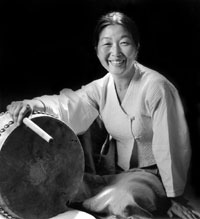
a Southeast Alaskan p'ansori in a prolog and five scenes
based on a story by Brett Dillingham
with a libretto by Chan Eung Park
for p'ansori singer, 3 vln, cl, bcl, hn, timp, gzh
(a version for mezzo-soprano is also available)
(-) First performance: 2005, Sheet'ka Kwaan Naa Kahidi Sitka Alaska, Chan Eung Park, p'ansori singer and The CrossSound Sinfonietta, cond.: Todd Hunt
Program notes
A couple of years ago the UNESCO declared a traditional musical form from Korea called pansori a world cultural heritage. P'ansori is often referred to as a one-person opera. One singer, accompanied by a drum almost exclusively using musical means tells a story in declamation-style, or stylishly recited, or in artfully sung sections that let him or her appear to be switching between the roles of the narrator and the characters like a chameleon. Klanott and the Land Otter People is probably the first attempt of a foreign composer to approach P'ansori creatively by composing a one person opera in this case on an Alaskan story inspired by native motives for a Korean p'ansori singer. This is not only the first attempt to write a piece like that but also as far as we know the first time a p'ansori singer is opening herself up for such new material. In Western music the 20th century has given me role models for one man operas. Foremost there is my own teacher's Hans Werner Henze's El Cimarron; the story of a Cuban slave. The subject matter of Klanott and the Land Otter People really matters today. It relates questions of our relation to nature to our relation to each other. The striking story by Brett Dillingham was turned into a moving libretto by Chan Eung Park with a breathtaking sense for the musical theater, which made composing the material a sheer pleasure. The many strands of this project come together in many ways in the person of the librettist/singer herself. Her full identification with the piece has lead to her fascinating interpretation of the score. Todd Hunt has most gracefully blent everything into a beautiful performance. Thanks to everybody involved in this fascinating project.
Stefan Hakenberg, 2005